Paint correction sounds surgical for a reason. You are literally leveling the uppermost microns of clear coat to remove defects that scatter light and dull the finish. Done well, even a ten-year-old daily driver can throw sharp reflections that rival a new showroom car. Done poorly, you end up with holograms, thinned paint, and a fresh round of sanding marks to chase. This is a craft that rewards patience, measured thinking, and disciplined technique.

What swirls, haze, and marring really are
Every time a wash mitt drags grit across a panel or a towel snags in a tight curve, you etch the clear coat. Swirls are tight, arced micro-scratches that bloom under a point light like spider webs. Haze is a broader loss of clarity, usually from improper compounding or aggressive clay that blurred the surface at a fine level. Marring is the generic name for incidental micromarring left by abrasive contact such as contaminated towels, old wash brushes, or even a rushed wipe during mobile detailing in direct sun. On soft paints, like many Japanese finishes, a single careless drying pass can leave a rash of marring. On hard German clear coats, the opposite happens, where heavy defects resist correction and tempt over-aggression.
Understanding the cause guides the fix. Rotary trails mimic the arc of a wool pad. Tighter, multi-directional scratches point to dirty washing. A grayish veil that refuses to pop under bright LEDs often means the last polishing step was underworked or the pad was clogged. The paint tells a story if you know how to read it.
The physics beneath the gloss
A flawless finish reflects light coherently. Defects break that coherence by creating tiny cliffs and valleys in the clear coat. Correction is controlled abrasion. You remove enough material to level the base of the scratch with the surrounding surface, not the other way around. That means every pass consumes clear coat, which is finite. OEM clear is typically 30 to 50 microns thick above the color coat, sometimes less. If a defect is 10 microns deep and your safe removal budget is 5 to 8 microns, full removal is impossible without risk. You blend, reduce, and refine until the scratch is harder to see in real-world lighting. Chasing absolute perfection can ruin a panel.
A working approach before the machine ever touches paint
Discipline starts with inspection and decontamination, the two steps many skip when DIY enthusiasm runs hot.
A thorough wash with a proper pre-rinse, contact wash, and careful drying removes the loose grit that would amplify damage. Iron fallout remover and a gentle clay process follow, but the clay must be chosen for paint hardness and the lube must stay generous. If clay drags or chatters, you are marring the finish. The second you feel that, swap to a softer bar or a synthetic clay mitt with more lube and lighten your touch.
Good lighting is not a luxury. Overhead shop lights reveal general condition, but a handheld LED spotlight or swirl finder, moved at shallow angles, reveals the truth. Note areas with repaints or bodywork because they respond differently. If you have a paint thickness gauge, build a map. Pay attention to edges and body lines where the clear is often thinnest. Decisions later will reference this map.
Machines, pads, and liquids, and how they actually behave
Polishers define the energy you put into the surface. A long-throw dual action unit is the workhorse for most paint correction. It cuts safely and finishes well, especially on modern clears. A rotary puts down more focused energy, perfect for heavy defects and spot work, but it requires an experienced hand to avoid holograms and heat spikes. Forced rotation polishers sit between them, adding bite without the full rotary learning curve.
Pads are not just density and color. Their cell structure, face design, and thickness change cut and finish. A thin, low-profile microfiber cutting pad on a long-throw DA will blitz through oxidation and heavier swirls on medium-hard paint, but load it up with spent clear and it starts to haze. A closed-cell foam finishing pad paired with a fine polish or “jeweling” polish can restore depth after compounding, but it will not pull out deep RIDS (random isolated deep scratches). Wool pads on a rotary cut hard and run cool for their aggression, an underrated combo when used correctly.
Compounds and polishes carry abrasive technology that matters more than the brand on the bottle. Diminishing abrasives break down into finer particles as you work them, so the window of effective cut narrows with each section pass. Non-diminishing abrasives maintain their cut longer, which can be helpful on hard paint or when choreographing a single-step correction. The liquid is only part of the chemistry. Priming a pad evenly, managing residue, and cleaning pads frequently keep the system predictable.
The correction ladder: start gentle, climb only as needed
When we triage a vehicle at On the Spot Mobile Detailers, the first test spot assumes less is more. One square foot, moderate pressure, moderate speed, and a mild polish on a polishing pad. On a well-kept car, that might be enough to erase wash marring and add crisp gloss without sacrificing clear unnecessarily. If the panel laughs at that combo, we move up to a light cutting pad and a medium-cut polish, then evaluate under multiple lights. Only if the defects persist, and only where needed, do we bring out a compound on microfiber or wool.
Progression stays intentional. If a heavy step fixes 90 percent but leaves haze, we do not automatically jump to a third full-panel step. Sometimes a targeted second pass on the worst areas, followed by a thoughtful refining step, balances results with preservation. The point is not to show off how aggressive you can be. The point is to leave the surface better, safer, and more durable.
Haze and the art of finishing
Haze is where experience shows. Two technicians can run the same polish on the same pad and end up with different clarity. Pad cleanliness is usually the first culprit, followed by too much pressure in the final passes or a polish that has dried past its optimal window. On soft black paint, a foam finishing pad and a very light finishing polish, primed evenly and worked at low speed with minimal pressure, will often clear the veil. Move the machine slower than feels natural and shorten the section size. Wipe with a plush, uncontaminated towel, ideally with a paint-safe prep solution that does not flash too fast.
On hard paints that fight you, jeweling with a rotary and an ultra-soft foam at slow speed can wring out the last two percent of clarity. This step is more art than science. You are tickling the surface, not pushing it. If you are seeing micro-holograms under cross lighting, come back with a DA for one quick finessing pass.
When defects do not disappear
Some defects are not meant to go away in a single story. Bird etching that sat through a summer, deep RIDS that catch a fingernail, or sanding traces from a previous repair can extend below your safe budget. In those cases, blend and mask. Reduce the contrast of the defect and improve the surrounding clarity so the eye does not catch it. If the customer is a realism-first kind of owner, walk them through the limits and why restraint protects the car’s long-term health.
Wet sanding has a place, but it is a scalpel. Start with higher grits than you think, such as 3000 to 5000, and sand in tight, controlled zones. Track your thickness before and after. If you do not have a gauge and rotary experience, err on the side of a cutting disc on a DA with a structured plan to refine your sanding marks. Many disasters start with a brave 1500 grit and end with a respray.
Controlling heat, keeping edges safe
Edges and peaks shed clear coat first because the film builds thinner there. Treat them as no-go zones for heavy cutting. Feather your passes off the edge and reduce pressure to almost none as the pad crosses a body line. Tape is not armor, it is a reminder. Watch your machine speed. On a rotary, a small bump in speed spikes heat quickly. On a long-throw DA, a loaded microfiber pad can stall on convex surfaces, which tempts users to push harder and tilt the pad. That tilt can burn a line before you feel it. Keep the pad flat and let the machine work.
Real-world variables that complicate the plan
Mobile detailing introduces wind and dust you cannot fully control. A gust during wipe-off can seed fresh grit into your towel and create new marring in the same area you just refined. In those settings, isolate correction zones, wipe slowly, and check towels obsessively. Humidity changes polish behavior. In high humidity, many compounds stay oily longer and wipe cleaner. In hot, dry weather, they can flash fast and dust, especially on microfiber pads. Adjust with a single spritz of pad conditioner or a dash of polish to extend working time, but avoid loading the pad with too much liquid. If you notice dust building along door edges and trim, pause and blow out the pad with compressed air.
The interplay between correction and ceramic coating
A ceramic coating locks in whatever you leave behind. If you half-finish a panel and coat it, you now have protected haze. The smartest path is to target your level of correction to the owner’s goals and the vehicle’s realities, then use the coating to preserve that win. Correcting to 80 to 90 percent on a daily driver and laying down a quality ceramic coating is a pragmatic balance. The coating’s slickness reduces wash-induced marring, and its chemical resistance buys time against etching. For show cars that see controlled use, you can justify deeper correction, then follow with a coating or a traditional sealant depending on the owner’s preference for feel and maintenance.
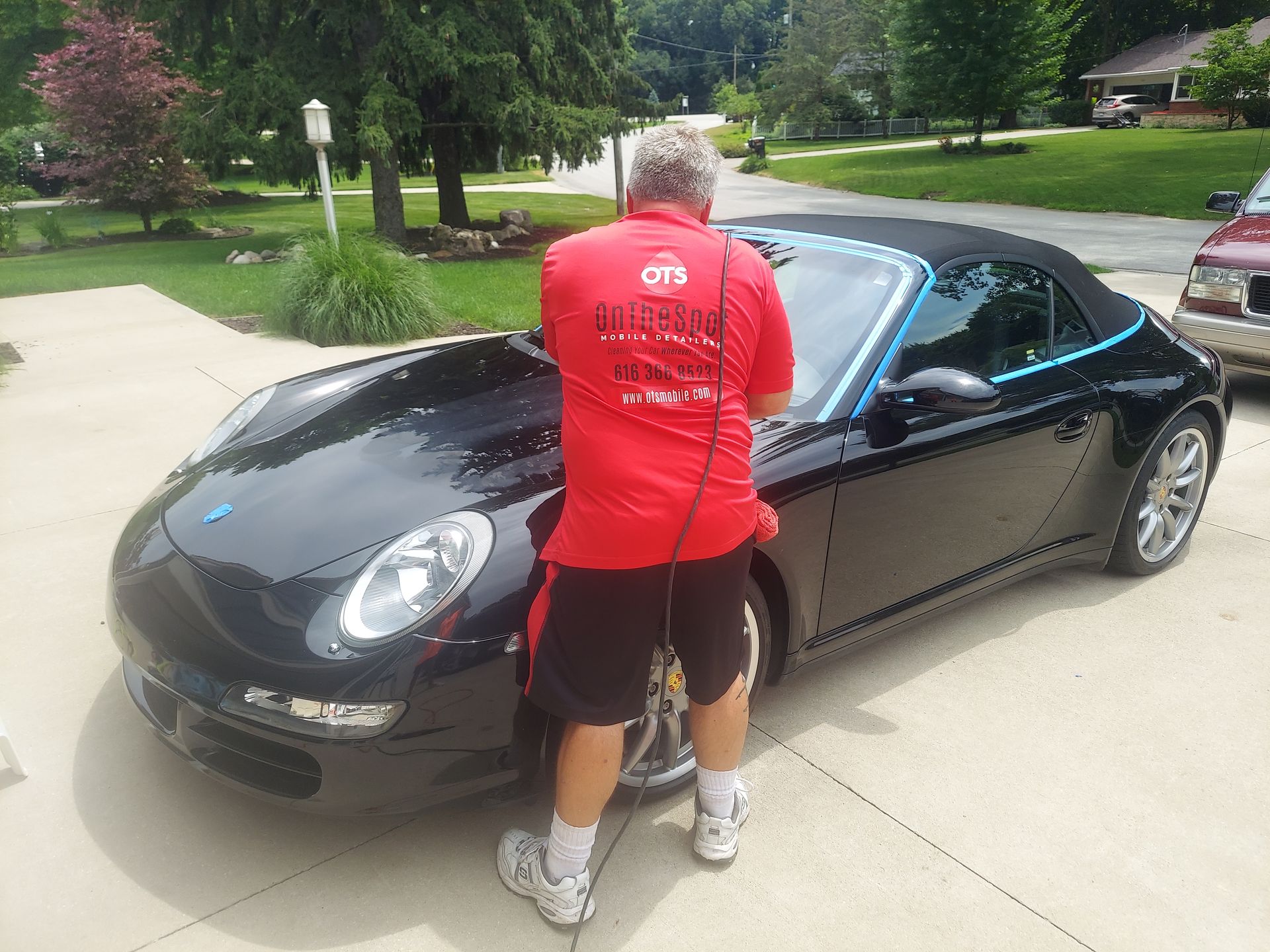
At On the Spot Mobile Detailers, we often pair mid-level correction with a wheel coating and select trim coatings because the visual payoff multiplies. Perfect paint beside dull wheels and gray trim never looks cohesive. Thirty extra minutes spent decontaminating and coating wheels can equal hours of extra shine in how the car reads at a glance.
Headlights, trim, and the adjacent surfaces that ruin the reveal
You can correct paint to a mirror and still feel let down if the headlights are cloudy. Polycarbonate lenses yellow and pit under UV exposure. Headlight restoration follows a similar logic: measured abrasion to remove the oxidized layer, followed by refinement and UV protection. Starting too aggressive leaves scalloped, uneven lenses that will haze again quickly. If you sand, step through grits methodically and finish with a proper coating or a dedicated UV sealant. A ceramic layer on lenses can dramatically extend clarity, especially on vehicles that live outdoors.
Textured plastic trim can steal polishing oils and stain. Mask it carefully. If compound dust embeds, an all-purpose cleaner and a soft brush helps, but sometimes you will need a dedicated trim restorer. After paint correction, consider a trim or interior coating strategy that fits the owner’s habits. A lightly used family hauler benefits from interior coating on high-touch areas because it simplifies cleanup without the greasy look of old dressings.
Case notes from the field with On the Spot Mobile Detailers
One of the more instructive jobs we handled at On the Spot Mobile Detailers involved a dark blue German sedan with obvious dealer-installed swirls and subtle haze across horizontal panels. The owner’s request was simple: make it look like it should have from new, not like it had been “detailed.” Our first test spot with a finishing polish on a yellow foam pad reduced the haze but left clear swirls under a scan light. We stepped to a microfiber cutting pad with a modern medium-cut compound on a long-throw DA. Two slow passes, pad kept flat and cleaned between cycles, pulled about 85 percent of the swirls with mild haze. A refining step with a soft foam pad and a fine polish restored clarity. Total clear removal measured between 2 and 3 microns in our test area, well within our comfort range.
We blended that approach across the car, protected edges, and reserved rotary use for a handful of deeper marks on the trunk lid where the factory paint measured thicker. After correction, we installed a ceramic coating on paint and wheels. The car transformed without any of the telltale rotary trails that had been haunting it under gas station lights. Six months later, the owner reported the wash routine had become faster, with less towel contact needed thanks to the coating’s hydrophobics, which kept fresh marring at bay.
Another memorable lesson came from a black pickup with repainted driver’s door. The repainted panel cut much faster than OEM panels. If we had applied a uniform process, we would have risked over-thinning the door. Instead, we dialed back to a mild polish there, accepted a little more residual marring compared to the adjacent factory panels, and then evened the overall look with careful finishing. It is better to accept a small mismatch in ultimate correction than to chase uniformity and sacrifice longevity.
Where RV, marine, and specialty surfaces diverge
Paint correction principles extend beyond passenger cars, but gelcoat and single-stage paints change the calculus. On RV detailing and marine detailing projects, gelcoat oxidation can be severe. You will work larger sections with more aggressive compounds and wool pads to cut through chalking. Gelcoat is thick, but it responds differently: it can load up pads with dead material rapidly, and it often benefits from a dedicated heavy-cut compound formulated for gel surfaces. Refinement is still essential, because a hazy hull or coach side looks dull even when it measures “flat.” Follow with a marine-grade sealant or a ceramic system suited to UV and salt exposure. The time investment is higher, and lighting becomes even more important on curved hulls where reflections can trick your eye.
Single-stage reds and whites on older cars will bleed onto your pads. That is not necessarily a problem, but it should change how you monitor residue and heat. For these, a gentle approach with more frequent pad swaps can maintain clarity without dragging pigment.
Finishing touches that separate good from great
After correction and protection, wipe-down technique matters. Many polishes hide microscopic residue that only shows under cross-polarized light or after the first wash. Do a controlled panel wipe with a paint-safe product. If the wipe reveals faint micro-marring, look to your towels. High-GSM, edgeless towels that have been washed without fabric softeners and air-dried tend to scratch less. If you are working outdoors, even a perfect towel can pick up grit from wind or nearby work. Fold often, check often, and never power through resistance during wipe-off.
Wheel coating and glass polishing round out the presentation. A coated wheel resists brake dust bonding and simplifies maintenance. Glass that has been clayed and lightly polished sheds water better, which changes how a car feels to drive in rain. The sum of these choices makes the end result read as intentional, not just shiny.
Maintenance that preserves the correction
Correction without a maintenance plan invites a return of the same defects. Two-bucket washing with grit guards, quality mitts, and a gentle pre-rinse cut re-introduction of swirls. Touchless pre-washes help in winter. Drying with forced air or a plush towel used softly, panel by panel, reduces post-wash marring. For coated cars, pH-neutral shampoos and periodic decontamination with iron remover keep the surface slick without heavy polishing. Spot-polishing a trouble area with a fine polish on a finishing pad can refresh gloss ceramic coating otsmobile.com without re-cutting the whole car.
Owners often ask how long a ceramic coating lasts. A fair answer is a range. A good professional coating can hold hydrophobics for 2 to 5 years depending on miles, wash habits, climate, and whether the car sleeps indoors. Protection does not equal invincibility. Bird bombs, bug acid, and hard water can still etch if left to bake. Quick response and a smart wash routine keep the finish closer to day-one for longer.
When to bring in help from On the Spot Mobile Detailers
There are projects where a DIY effort makes sense and others where a shop’s tooling, lighting, and measured process save time and clear coat. On the Spot Mobile Detailers has spent many hours troubleshooting paints that behave strangely, from super-soft jet black that marrs from a stern look, to hard silvers that laugh at mild abrasives. The benefit of repetition is pattern recognition. If your test spots leave trails, if you cannot clear a persistent veil, or if a previous repair panel measures thin, a second set of hands can prevent irreversible mistakes.
We see crossovers too. A full paint correction paired with residential coating and interior coating services turns a daily driver into an easier-to-live-with machine. Families that juggle sports gear, dog hair, and long commutes appreciate surfaces that release grime more readily. Balance matters: a one-step polish that lifts gloss and wipes minor haze, followed by coatings on paint, wheels, and high-touch interiors, can be the right answer for use cases where time is tight and results need to endure.
A simple, high-yield checklist for safer correction
- Map the paint with lighting, note repaints, measure if you can, and identify edges to avoid. Decontaminate thoroughly, and keep clay lube generous to prevent fresh marring. Start with the least aggressive test spot, escalate in small steps, and rescue finish with a proper refining pass. Clean pads often, control heat, keep the pad flat, and let the machine do the work. Protect wisely with ceramic coating or sealant, then maintain with gentle wash and dry habits.
What mastery feels like
Great correction work feels quiet. The machine hums, residue stays controlled, towels glide without protest, and defects retreat predictably. The car under strong light reveals clarity, not just shine. If you can read the surface and adjust one variable at a time, you can solve almost any swirl, haze, or marring scenario without gambling with clear coat.
The more you correct, the more you respect restraint. Deep defects invite bravado, but long-term beauty lives in preserving microns for the future. Whether you are tuning a new coupe for ceramic coating or bringing an older truck back from years of tunnel washes, the path is the same: listen to the paint, choose the gentlest tool that works, and refine until the reflections stop shouting and start singing. That is the difference between a car that looks glossy at noon and one that still looks crisp under a streetlight at midnight.
On the Spot Mobile Detailers: process, pacing, and the right priorities
The goal at On the Spot Mobile Detailers has never been to sell the heaviest correction. It is to pair the right level of intervention with smart protection so the results last. We rely on measured test spots, incremental pad and polish changes, and a strong finishing game. We also integrate adjacent services when they enhance the overall effect. Headlight restoration, wheel coating, and targeted interior coating on high-wear touchpoints often deliver outsized value compared to chasing the last scratch on a rocker panel that will pick up road rash again in a week.
If you approach paint correction with that same mindset, you will end up with vehicles that look right, age well, and ask less from you over time. The craft is teachable, but the judgment takes miles. The good news is that the paint keeps teaching, panel by panel, for anyone willing to pay attention.